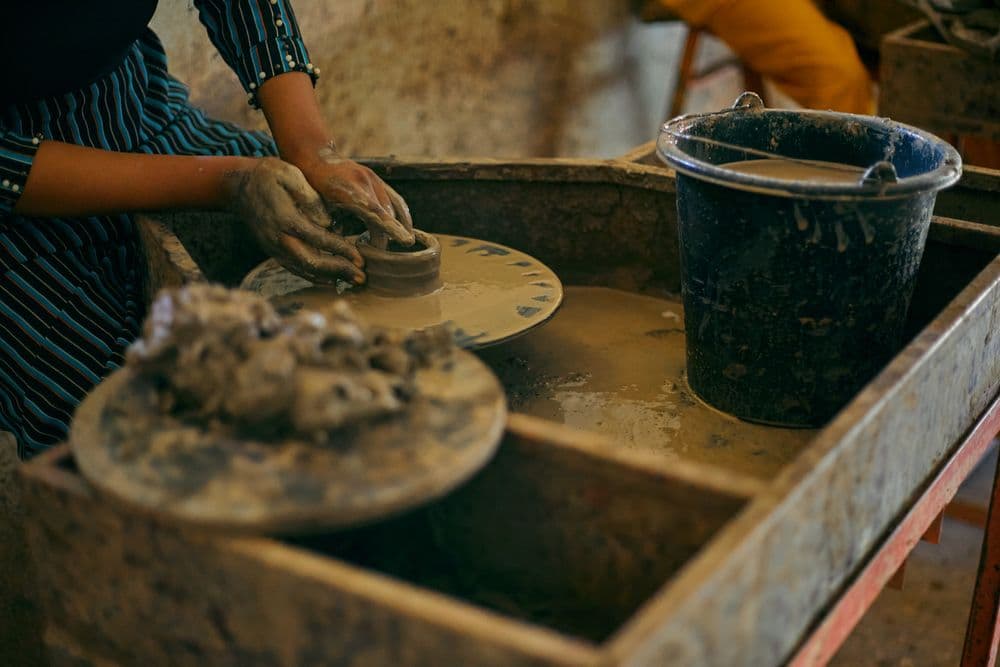
An electric kiln is enough for bisque and glaze firings. Choose its size from the pieces your classes produce each week, and check your studio's power supply first, because above 3.68 kW a kiln no longer runs from a standard socket. On 25 November 2026, a 60-litre Plutón 2S cost €2,843.50 including VAT in Spain and a Nabertherm TOP 60 €3,695. In the TOP 60, firing 45 cups, bisque and glaze, costs €11.67 of electricity excluding VAT at the average business rate. For wheels, plan one per place; Spanish shops ranged from €94.90 for a 350 W VEVOR to €2,997.50 for a Brent C.
See how Aforo Arts handles thisElectric or gas
An electric kiln heats with elements and follows the firing curve you set on its controller. It fires in oxidation, with air inside, which suits bisque and the glazes sold for electric kilns. It only needs an electrical supply that can carry its power, which makes it the easiest kiln to install in a studio.
A gas kiln burns propane or natural gas and can fire in reduction, with little oxygen in the flame, which gives stoneware and porcelain different finishes. In return it needs a gas installation by a licensed installer, a flue and more experience to run each firing. Raku is fired in small gas kilns, usually outdoors. None of the Spanish shops consulted published a price for a gas kiln.
- If you fire bisque and glaze for your students, an electric kiln is enough.
- Reduction and raku need gas, and raku needs an outdoor space.
- Before buying a gas kiln, talk to your installer and your insurer.
Single-phase or three-phase: check your supply first
The kiln's rating plate gives its power in kilowatts and how it connects: single-phase at 230 V or three-phase at 400 V. A standard 16-amp socket in Spain delivers at most 3.68 kW, which is 230 times 16, so only the smallest kilns plug in without electrical work. Some 60-litre kilns stay at 3.6 kW, such as the Nabertherm TOP 60, and the 3.6 kW Rohde Ecotop 60 comes with a Schuko plug. Others of the same size, such as the 5 kW Plutón 2S, already need their own circuit, and the single-phase Nabertherm TOP 80 needs a 32-amp outlet. In the shops consulted, every kiln of 150 litres or more for 1,300 °C was three-phase.
Also check the contracted power on your electricity bill. While the kiln fires, its load adds to everything else in the studio, and if you go over your contracted power the meter cuts the supply. A qualified electrician can tell you whether the circuit can take it and what needs changing.
- Find the power (kW) and connection (230 V or 400 V) on the spec sheet.
- Compare that power with the contracted power on your bill.
- If your studio has no three-phase supply, get a quote before choosing a kiln that needs it.
How many litres
Kilns are measured by the litres in their chamber. To choose, count how many pieces your classes produce each week and how many fit in one load: the spec sheet gives the interior dimensions, and from them you can work out how many shelves fit and how many pieces go on each. As a guide, Nabertherm counts 45 cups per load in its 60-litre kiln and 66 in its 100-litre one.
A kiln is fired full. If it takes a month to fill, your students' pieces wait a month; if it is too small, you fire more often and spend more hours loading and watching it. And allow for two firings per piece, bisque and glaze.
- Count the pieces produced each week, not the people the room holds.
- Ask for the interior dimensions and usable height, not just the litres.
- Leave room for the growth you expect this year.
What a new kiln costs
Including VAT, on 25 November 2026 the cheapest electric kiln for 1,300 °C in the shops consulted was the 23-litre Plutón 0S, at €2,123.55. For 60 litres, the Plutón 2S cost €2,843.50 and the Nabertherm TOP 60 €3,695. In the table, kilns of 100 to 200 litres ranged from €4,005.10 to €4,495. All the kilns in the table open from the top; the front-loading Nabertherm kilns, which open like a cupboard, cost over €5,000.
On top of the kiln price, add delivery, any electrical work and the set of shelves and props to load it, which several shops sell separately for €70 to €370 plus VAT, depending on the model. Several kilns were out of stock or took about three months to arrive, and some shops ask about your electrical supply before giving a final price.
- Compare prices including VAT and ask what they include: shelves, props and delivery.
- If you have a date for your first firing, ask about delivery time before paying.
- Have your contracted power to hand, and whether you have three-phase, when you ask for a quote.
| Model | Chamber | Power supply | Price incl. VAT | Shop |
|---|---|---|---|---|
| Plutón 0S | 23 litres | 2.3 kW · single-phase | €2,123.55 | Micesa |
| Plutón 2S | 60 litres | 5 kW · single-phase | €2,843.50 | Micesa |
| Nabertherm TOP 60 | 60 litres | 3.6 kW · single-phase | €3,695.00 | Arte y Cerámica |
| Plutón 3S | 76 litres | 6 kW · single-phase | €3,127.85 | Micesa |
| Nabertherm TOP 100 | 100 litres | 7 kW · single- or three-phase | €4,495.00 | Arte y Cerámica |
| Plutón 5S | 160 litres | 9 kW · three-phase | €4,005.10 | Micesa |
| Plutón 6S | 200 litres | 10 kW · three-phase | €4,422.55 | Micesa |
Prices read on each shop's website in Spain on 25 November 2026, the week of Black Friday, so some may be offers. They exclude delivery, installation and kiln shelves. Kádar and Arte Vértice publish prices without VAT and are not in the table.
What each firing costs
A firing costs the kilowatt-hours it uses times the price per kWh on your bill. Some manufacturers give consumption on the spec sheet, and some controllers show it at the end of each firing. If you do not have it, power times firing hours gives you the maximum: a 3.6 kW kiln that fires for 10 hours uses at most 36 kWh. The elements switch on and off to follow the curve, so actual use is lower.
According to Nabertherm, its 60-litre TOP 60 uses 48.3 kWh to fire 45 cups, bisque and glaze. At the average electricity price in Spain for businesses using less than 20 MWh a year, €0.2417 per kWh excluding VAT in the first half of 2026 according to Eurostat, that comes to €11.67 for both firings, about 26 cents per cup.
- Use the consumption on the spec sheet if it has one; if not, work out the maximum.
- Divide the cost of the load by the pieces in it.
- If you charge for firings separately, review that price when your electricity tariff changes.
Second-hand kilns: what to check
A used kiln costs less, but the parts that wear with use are exactly the ones that are expensive to replace. Ask to see it running or to see its log of recent firings, and read the rating plate before discussing price. On 25 November 2026, Wallapop, the Spanish resale site, listed a single-phase Nabertherm for €1,500 and a 7.5 kW ISUNI for €2,490.
- Elements: no broken sections, none out of their grooves or badly distorted.
- Thermocouple and controller: it reaches the temperature shown, without errors.
- Brick and lid: a hairline crack is normal; a missing piece or a lid that does not close is not.
- Rating plate: voltage, connection and power that suit your studio.
- Transport: ask for the weight and measure doors, corridors and stairs.
Where to put it
The outside of a kiln is hot for hours, and during bisque it gives off smoke and smells from the organic matter in the clay. Put it in a ventilated room, on a non-combustible floor and at the distance from the walls given in its manual. If you teach, keep it out of the students' way.
- Follow the manufacturer's clearances and ventilation.
- Keep the kiln out of the class's path.
- If it shares a room with classes, schedule firings outside class hours.
What to look for in a wheel
On an electric wheel, motor power and the kilos of clay it can centre tell you what pieces you can throw. The pedal must give a steady speed at low revs, where beginners work. Also check that it turns both ways, that the splash pan comes off for cleaning and that it runs quietly, because several run at once in a class.
- Compare power (W) and clay capacity (kg) on the spec sheet.
- Try the pedal at low speed before buying.
- If you can, use the same model for every wheel in a class.
What a wheel costs
Leaving out toy wheels, on 25 November 2026 a new electric wheel cost from €94.90 including VAT, a discounted 350 W VEVOR on Amazon, to €2,997.50, a Brent C. The 350 W VEVOR centres about 5 kg of clay, enough for cups and bowls. The Shimpo and Brent wheels in the table centre 35 to 102 kg and handle large pieces.
Before comparing prices, check whether the pedal is included: the Quark S+ is sold without one, and with the pedal it comes to €916.75. Second-hand, Wallapop had wheels that day from €60 for used VEVORs to €1,200 for a Shimpo.
- Compare prices with the pedal included.
- Ask about delivery: a studio wheel weighs 40 to 55 kg.
- On a used wheel, try the pedal and listen to the motor before paying.
| Model | Clay capacity | Motor | Price incl. VAT | Shop |
|---|---|---|---|---|
| VEVOR, 28 cm wheel head | 5 kg | 350 W | €94.90 | Amazon.es |
| Quark S+ | 12 kg | 250 W | €785.10, no pedal | Marphil |
| Shimpo Whisper-T | 35 kg | 1/3 hp | €1,452.00 | Marphil |
| Shimpo RK-3D | 45 kg | 400 W | €1,754.50 | Marphil |
| Shimpo RK-3E | 75 kg | 400 W | €1,984.40 | Marphil |
| Brent C | 102 kg | 550 W | €2,997.50 | Taller Gingell |
Prices read on each shop's website in Spain on 25 November 2026. The VEVOR was 29% off that week, and the Quark S+ pedal costs €131.65 extra. Shimpo wheels cost the same at Marphil and Esmaltycolor. Delivery not included.
How many wheels you need
Each student uses their own wheel for the whole class, so a throwing class has as many places as wheels. With six wheels, you open six places even if the room holds more people. If the teacher demonstrates, count one more for them. And if you want more students in the same slot, you can run a hand-building class at the same time, with its own places.
- Count one wheel per place, plus the teacher's if they use one.
- For beginners, open a place or two fewer than wheels: they need more help at first.
- Set aside wheels for open studio time in slots that do not clash with classes.
What Aforo Arts does in a pottery studio
In Aforo Arts, each throwing class opens as many places as the wheels you assign to it, and if another activity needs those wheels at the same time, you see it in the calendar before you open it. Open studio time is one more activity, with its own schedule, places and price.
From the Pro plan, each open studio booking deducts a session from the student's pass, clay and firings are sold as extras at booking, and every piece is tracked with its photo and shelf through drying, bisque, glaze and collection.
- Places per wheel in every class, with clashes visible in the calendar.
- Passes for open studio time, from Pro.
- Clay and firings as extras, and piece tracking, from Pro.
Bring your activities into Aforo Arts
Show us how you run courses, workshops and groups. We will walk through your formats.